“I hate Sundays!” Despite the fact that it has been forty-five years, I can remember shouting this sentence (in my head) as clearly as if it were yesterday. The scariest and simultaneously most fascinating aspect of this obscure childhood memory is the extraordinary restraint exhibited by my seven year old self, not only in avoiding the vocalization of a sentiment, which in my staunchly religious, Missionary Baptist home would have been considered the height of blasphemy, but also in the fact that even the thought was self-censored to a degree. The truth, you see, is that I did not really hate Sundays; what I actually hated was going to church!
Organized religion in the 21st Century is decidedly much more “kid-friendly” than when I was a seven-year-old in 1970. Today’s diminutive worshipers have luxuries such as “Children’s Church” in which they are allowed to escape the confines of the adult service in favor of snacks, art projects, and Veggie Tales DVDs for all, or at least part, of the morning religious  ritual. My current church also offers school-aged children “Busy Bags” – great little care packages filled with puzzles, games, stories, and coloring materials to help pass the time. Additionally, the “run-time” of morning worship at the racially integrated, American Baptist church that my Caucasian husband and I now attend is a mere one-hour and fifteen minutes, unlike the marathon sessions of the African-American Baptist church to which I belonged as a child. So to my friends and relatives who remain on the extreme religious right, now poised to bury me alive in a deluge of indignant email and vitriolic Facebook posts, please give me a chance to explain.
My aversion to church was not the premature manifestation of atheistic tendencies. I had no doubt, then as now, that God existed. At Christmas time, when my mother would set up the Woolworth’s ceramic Nativity scene (complete with the stable she made from a cardboard box that was a remnant of my father’s short-lived part-time career as a salesman for the Mason Shoe Company), I would gaze adoringly at the tiny, blue-eyed, blonde haired, haloed Baby Jesus for hours. At Easter, I would experience genuine sadness upon hearing the terrible story of the crucifixion, knowing at some deep, visceral level that my “sins”, whatever they might be, were to blame for the horrific suffering which that nice Baby Jesus had grown up to endure. It wasn’t God, or Jesus, or even Christianity as a concept that offended my childish sensibilities. Instead it was the fact that somehow, I knew, even in the naiveté of my extreme youth, that the activities that many of the adult “church folk” around me were trying to pass off as “faith” just weren’t what Jesus really had in mind.
In all the stories of Jesus and his disciples, it always seemed to me that, despite his extraordinary abilities: turning water into wine, healing the sick, raising the dead, etc. Jesus was also “one of the guys” in many ways. He joked with his followers and teased them, especially brass, often “foot-in-mouth” Simon Peter. When The Twelve started freaking out during a storm, rudely awakening Jesus from a much needed nap, (raising the dead has GOT to take a lot out of person, even if He is the Son of God for goodness sakes!), I could always imagine Jesus stumbling up on deck, with a mad case of “bed head” shouting at the waves, “Peace! Be still!” and staggering back to bed, greatly annoyed at having been disturbed from his rest thinking, “Do I have to do EVERYTHING around here?”
In contrast, however, African-American church pastors of that era seemed to occupy an artificially exalted position, an odd hybrid of corporate bigwig and tribal chieftain. I remember one pastor who strutted about the pulpit wearing these impossibly shiny, sharkskin suits, looking more like a member of the Motown group, The Temptations than a humble man of God. Later, black preachers began to wear elaborate robes, of varying colors and trimmed in velvet, or braided cords of red or gold. During afternoon services where several congregations might come together these men would sit in ostentatious alignment before their combined congregations reminding me, even at that young age of the ill-tempered, aging peacocks that made a habit of tormenting the children at the Deming Park Zoo. This image from the memorial service for Charleston, South Carolina church shooting victim, Pastor Clementa Pinckney, with a dozen or so of these similarly outfitted individuals providing an alarmingly familiar backdrop for the President as he delivered the eulogy.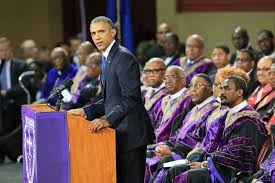
What always bothered me, even as a youngster, was the faint but distinct odor of insincerity amid all this pompous posturing. Pastor “Shiny Suits” was eventually ousted from our church in a bitter no confidence vote, but not before he nearly bled the church treasury dry, in what was apparently a payoff designed to make him go away. Others would preach that we should follow the example of the Good Samaritan by showing kindness to strangers or that we should turn the other cheek when wronged by another, and in the next breath spout the most hateful, homophobic rhetoric imaginable.
So, what was up with that? CNN contributor, the Reverend DeForest Soaries, Jr. offered a clue in a 2010 opinion piece, Black Churches and the Role of Empowerment (Rev. DeForest Soaries). The remnants of slavery and 100 years of Jim Crow segregation were powerful forces in undermining feelings of self-worth among African-Americans. The church was the one area where blacks could feel respected, valued, and perhaps, most importantly, experience the thrill of wielding not only autonomy, but power in various forms. Sadly, however, it is clear that power, whether real or imagined, has the tendency to corrupt. This became painfully clear to me when I chanced upon an online article about the fate of one of my former churches, Friendship Baptist Church, in Lansing, Michigan, where I was a member from 1997 until I moved away in 2005 and where my husband and I were married, and our late son was baptized more than a decade ago. This sordid tale of two factions battling for control, each accusing the other of a host of decidedly un-Christian misdeeds within a church that I had truly loved and steadfastly believed embodied the spirit of its name – “Friendship” – left me with a deep despondency to say the least (Hinkley).
In spite of all of this, however, I no longer hold the animosity for Sundays in general, or organized religion specifically that I once did. I have come to realize that, much like the childhood game of “Telephone” where a perfectly reasonable message can be hopelessly lost in translation as it is relayed from person to person, the true purpose of faith can be subject to an equally unhappy fate when placed freely at the disposal of flawed human beings. This is no reason, however, to simply throw up our hands and walk away in utter exasperation. Pope Francis, recently on an historic visit to the United States, remarked in a 2013 interview with America magazine that “discernment” was a critical pillar of his own personal ministry (Spadaro). The challenge is to recognize that our interpretation of “God’s will” may have been corrupted by selfish desires, the prejudices of ourselves and others, our own limited understanding, and the distortion of God’s word (both inadvertent and intentional) by those around us. By striving always to approach faith, worship practices, and life itself with the “open mind and open heart” recommended by the current pope, I am learning to reconcile my differences with Sundays. Thankfully, we are on speaking terms again, enjoying each other’s company not only in formal worship services but also in the relaxed and loving society of family members and friends. I suspect that there is a long and beautiful relationship ahead.
Works Cited
Hinkley, Justin. “How Friendship Baptist Became a ‘Powder Keg’.” 31 August 2014. Lansing State Journal. 24 September 2015.
Rev. DeForest Soaries, Jr. “Black Churches and the Role of Empowerment.” 1 August 2010. CNN. 24 September 2015.
Spadaro, Antonio. “A Big Heart Open to God.” America: The National Catholic Review 30 September 2013.
 quietlyradical