With the 2020 elections just a little more than 18 months away, politicians and the general public are already squaring off to determine which side is “right” and which is “wrong”, since the concepts of compromise and a viable “middle ground” on economic and political issues seem to have drifted into complete oblivion. Online forums such as Facebook and Quora are already alive with increasingly hostile debates in which terms such as “Socialist!” or “1 %” are thrown down as the gauntlets in 21st century verbal duels. The ongoing dispute over how much influence government should have in our lives seems dangerously similar to the “States’ Rights” arguments that precipitated the start of the American Civil War some 158 years ago.
As a life-long Democrat from a family of Democrats, I have often sought to understand the conservative point of view and while I will probably never be able to wrap my head completely around GOP ideology, there is one idea in all of the literature about “them” that seems to recur again and again – “small” government is better. However, why is this idea so popular and what does small government really look like from a practical perspective? 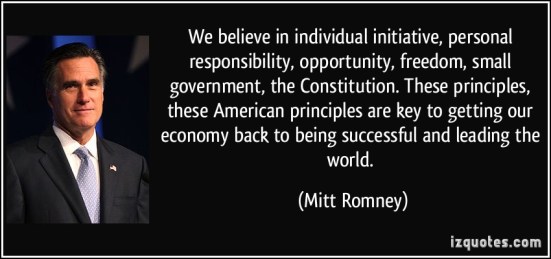
One of the earliest references to the idea of limited government intervention is a quote widely attributed to Thomas Jefferson which reads, “That government is best which governs least, because its people discipline themselves.”
What caught my attention right away, however, is that while I have often heard the “government is best which governs least” part of this quotation, the second half, “because its people discipline themselves” was completely unfamiliar to me. As I considered the quote in its entirety, I think I finally began to understand the basic difference between liberal and conservative points of view. Conservatives put their faith in the “rugged individualism” of people while maintaining a significant measure of distrust of the government, while for liberals, the opposite is true. So which perspective is the more reasonable of the two? Can average Americans really be trusted to “discipline ourselves.” 
In Thomas Jefferson’s time, the U.S. economy was fueled largely by pursuits such as farming, fishing, fur trapping and trading, and a small merchant and service class that supplied farmers, fisherman, and traders with the goods and materials which they could not easily produce on their own. The self-sufficiency of these early Americans lent itself to a relatively “laissez-faire” form of government. People had no choice but to exercise a large measure of self-discipline since failure to do so would have quickly resulted in starvation. However, it could be argued that as time went on and the country continued to grow, so did greed and selfishness.
For example, forcibly taking land from Native Americans and compelling them onto reservations in a quest to develop the West is probably not a shining example of self-discipline and neither is the enslavement of 4 million people of African descent in order to secure free labor for southern plantations (Henry Louis Gates, 2014). 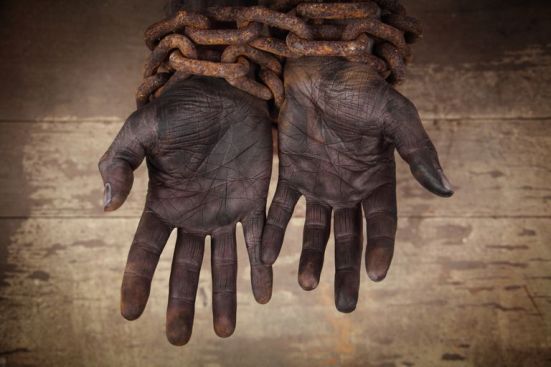 Additionally, while the Industrial Revolution of the late 18th and early 19th centuries was a prime example of the benefits of capitalism and a free market society in terms of economic growth, without government regulation factory owners were able to get away with paying low wages and subjecting workers, including children, to horrific working and living conditions (Working and Living Conditions).
With no federal income tax until 1913, the “Gilded Age” of the mid to late 19th century saw a widening income gap as the growth of the railroads and the oil and steel industries made a very few people very, very rich. 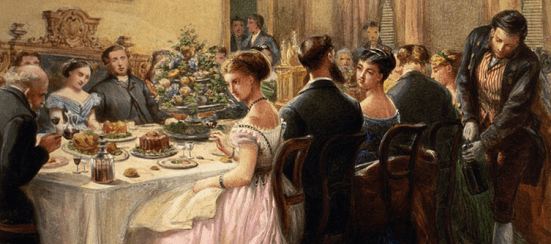 In 1918, John D. Rockefeller is reported to have had a net worth of $1.2 billion, which is the equivalent of $340 billion in today’s dollars (Lord, 2018). Capitalism, largely unfettered by government regulation resulted in the formation of monopolies which led to higher prices for consumers, the inability of new companies to break in to certain industries, and political corruption as super rich business owners possessed the power to control government officials (Lowrey). Then, as now, the wealthy were, quite predictably, vehemently opposed to any type of wealth redistribution or social safety net to help those living below the poverty line. Social Darwinists such as Herbert Spencer and William Graham Sumner embraced the philosophy of economic survival of the fittest and “viewed individual competition for property and social status as a tool for eliminating the weak and immoral of the population” (Social Darwinism). One of the major arguments against social programs such as Medicare for all or free university education is that charities and philanthropic organizations, rather than government, are better suited to financing the safety net for the less fortunate and many invoke the name of Andrew Carnegie as proof that unbridled capitalism would create a class of the ultra-rich whom we would trust to wisely and fairly redistribute some self-determined portion of their wealth to the poor through the mechanism of philanthropy. Although Carnegie gave away $350 million during the course of his lifetime, some argue, however, that Carnegie’s methods were less than egalitarian and his motives less than pure. For example, writer Kathleen Davis argues that rather than sharing his wealth in the form of higher wages and better working conditions for his employees, Carnegie instead focused on largely symbolic investments, such as libraries and the famous Carnegie Music Hall.
  She suggests that Carnegie’s supposed generosity was not really about helping the poor but was, instead a mechanism for “obscuring the man’s ruthless accumulation of economic capital, and of course, political power” (Willis, 2016).
Although Social Darwinism in its purest form began to decline at the dawn of the 20th century, a slightly repackaged version of it emerged in the philosophy of rugged individualism, popularized during Herbert Hoover’s 1928 presidential campaign (UVA Miller Center). Hoover’s devotion to the ideas of self-reliance and removal of governmental interference with businesses along with promises of continued peace and prosperity were likely the key factors that propelled him to the presidency. However, the stock market crash of 1929, created in large part by the colossal failure of overconfident investors to discipline themselves and made worse by public panic and “bank runs” (Marks, 2018) put the “rugged individualism” philosophy to a severe test. While Hoover stayed the course by refusing to institute widespread relief programs, the public, upon living through the consequences of a “small government” philosophy firsthand, suddenly seemed less certain that total self-reliance was the most desirable course of action.
In the ongoing media wars between liberals and conservatives the spotlight always seems to shine most brightly on controlling the size of government. Perhaps, however, time and effort would be better spent focusing on the self-discipline side of the equation. Former New York Mayor Michael Bloomberg set off a firestorm of protest when he suggested a ban on oversized sugary drinks; however, the U.S. has the highest percentage of obese people among all countries worldwide, casting doubt on our self-discipline in this area (Sassi, 2013). According to fire ecologist Melissa Forder, humans cause about 84% of all forest fires in the United States. Careless smoking and errant campfires cast doubt on the ability of Americans to exercise the self-discipline necessary for “small government” to work effectively in environmental realms either (Joyce, 2017). Proponents of “small government” would likely support the removing of laws designed to regulate cellphone usage behind the wheel despite the fact that the National Safety Council reports that distracted driving crashes cause the deaths of nine Americans and the injury of 100 others on a daily basis (National Safety Council, n.d.).  Finally, it is always interesting how those who lecture others about “personal responsibility” are themselves, quite lacking in this regard. Take, for example, political pundit, author, and former Fox News host, Bill O’Reilly, who regularly sermonized about how people should “stop making excuses” for their bad behavior, yet proceeded to do the same thing when he was fired from his popular show The O’Reilly Factor after allegations of sexual harassment came to light (Baragona, 2017). Another extreme example is the case of comedian Bill Cosby, who in 2004 went off on a moralizing rant during a speech at an NAACP event in which he chastised low-income African Americans for failing to take responsibility and do the work necessary to improve their lot in life (Serwer, 2018). The infamous “Pound Cake Speech” drew both praise and condemnation from all sides, but its content seems especially ironic now given Cosby’s conviction for sexual assault. Where was his self-discipline when he decided to drug countless women for the purpose of engaging in non-consensual sexual acts?
While Americans are quick to cite distrust of the government as a reason to limit its influence upon our lives, it would appear that the rest of us aren’t that “squeaky clean” either. For example, the American Psychological Association (APA) estimates that infidelity was the cause for 20 to 40% of all divorces, and that 42% of divorced people admitted to having had more than one affair (Martin, Christensen, & Atkins, 2014). The IRS estimates a $458 billion average annual difference between taxes that are owed and actually paid (Pianin, 2016). Daniel McCabe of Rutgers University conducted a survey of 63,700 U. S. undergraduate students and 9,250 graduate students over a 3-year period and found that nearly 40% of the undergrads and about 25% of the graduate students admitted to copying or paraphrasing information from either an Internet or written source without citing the reference (Plagiarism: Facts & Stats, 2017). A 2017 HireRight employment screening benchmark report indicated that 85% of all employers have reported finding false information on applicants’ resumes or applications, up from just 66% in 2012 (O’Donnell, 2017). According to Psychology Today, in a survey of over 1,000 online daters, 53% of them admitted to having lied on the dating profiles (Anderson, 2016) and finally, in the classic work-related deception, CareerBuilder found that 40% of American workers have falsely called in sick at least once in the last twelve months (Career Builder).

These statistics don’t really instill confidence in the average American’s ability to govern himself in the absence of the forced discipline that at least some measure of government intervention ensures. The United States often seems like the unruly teenager, who despite having crashed his car repeatedly while still driving on just a learner’s permit, insistently demands his “right” to unrestricted driving privileges.
Individual freedom is a wonderful thing and one of the many benefits of life in these United States. However, perhaps instead of asking for a government which “governs least” what we actually should be seeking is a government which governs sensibly and responsibly, since, if we are to be completely honest, many of us are currently incapable of doing for ourselves.
Works Cited
Anderson, R. (2016, September 6). The Ugly Truth About Online Dating. Retrieved from Psychology Today: https://www.psychologytoday.com/au/blog/the-mating-game/201609/the-ugly-truth-about-online-dating
Baragona, J. (2017, October 24). Chris Hayes Mocks O’Reilly Taking Personal Responsibiltu by Using Old O’Reilly Factor Segment. Retrieved from Mediaite: https://www.mediaite.com/online/chris-hayes-mocks-oreilly-on-taking-personal-responsibility-by-using-old-oreilly-factor-segment/
Career Builder. (n.d.). Press Room. Retrieved from CareerBuilder: http://press.careerbuilder.com/2017-11-16-Increased-Number-of-Workers-Calling-In-Sick-When-They-Arent-Finds-CareerBuilders-Annual-Survey
Henry Louis Gates, J. (2014, February 10). Slavery, by the Numbers. Retrieved from The Root: https://www.theroot.com/slavery-by-the-numbers-1790874492
Joyce, C. (2017, February 27). What’s the Leading Cause of Wildfires in the U.S.? Humans. Retrieved from NPR.org: https://www.npr.org/sections/thetwo-way/2017/02/27/517100594/whats-the-leading-cause-of-wildfires-in-the-u-s-humans
Lord, B. (2018, September 28). America 2018: Even More Gilded Than America 1918. Retrieved from Inequality.org: https://inequality.org/great-divide/america-2018-more-gilded-america-1918/
Lowrey, A. (n.d.). What Are Monopolies? Retrieved from Gilded Age America: https://gildedageamerica.weebly.com/monopolies-and-its-effects-on-america.html
Marks, J. (2018, April 13). What Caused the Stock Market Crash of 1929? Retrieved from History.com: https://www.history.com/news/what-caused-the-stock-market-crash-of-1929
Martin, R., Christensen, A., & Atkins, D. (2014). Infidelity and Behavioral Couple Therapy: Relationship Outcomes Over 5 Years Following Therapy. Couple and Family Psychology: Research and Practice, 3.
National Safety Council. (n.d.). April is Distracted Driving Awareness Month. Retrieved from National Safety Council Website: https://www.nsc.org/road-safety/get-involved/distracted-driving-awareness-month?utm_campaign=Driving+Safety+Dist-Driving&utm_source=adwords&utm_term=texting%20and%20driving%20facts&utm_medium=ppc&hsa_cam=283297839&hsa_ad=225680089408&hsa_net=adwords&hsa_a
O’Donnell, J. T. (2017, August 15). 85 Percent of Job Applicants Lie on Resumes. Here’s How to Spot a Dishonest Candidate. Retrieved from Inc.: https://www.inc.com/jt-odonnell/staggering-85-of-job-applicants-lying-on-resumes-.html
Pew Research Center. (2019, April 11). Public Trust in Government: 1958-2019. Retrieved from Pew Research Center: https://www.people-press.org/2019/04/11/public-trust-in-government-1958-2019/
Pianin, E. (2016, April 29). IRS Now Pegs Tax Cheating by Americans at $458 Billion Annually. Retrieved from The Fiscal Times: https://www.thefiscaltimes.com/2016/04/29/IRS-Now-Pegs-Tax-Cheating-Americans-458-Billion-Annually
Plagiarism: Facts & Stats. (2017, June 7). Retrieved from p.org: https://www.plagiarism.org/article/plagiarism-facts-and-stats
Sassi, F. (2013, April 11). How U. S. Obesity Comparies With Other Countries. Retrieved from PBS New Hour: https://www.pbs.org/newshour/health/how-us-obesity-compares-with-other-countries
Serwer, A. (2018, April 26). How Bill Cosby’s ‘Pound Cake’ Speech Led to His Downfall. Retrieved from Atlantic: https://www.theatlantic.com/entertainment/archive/2018/04/how-cosbys-pound-cake-speech-helped-lead-to-his-downfall/559049/
Social Darwinism. (n.d.). Retrieved from History: https://www.history.com/topics/early-20th-century-us/social-darwinism
UVA Miller Center. (n.d.). Herbert Hoover’s “Philosophy of Rugged Individualism” Campaign Speech. Retrieved from Philosophy of Rugged Individualism: https://millercenter.org/the-presidency/educational-resources/philosophy-of-rugged-individualism
Welch, M. (2018, November 22). Americans Don’t Trust Their Government, Its Institutions, or Each Other. Retrieved from Los Angeles Times: https://www.latimes.com/opinion/op-ed/la-oe-welch-low-trust-20181122-story.html
Willis, M. (2016, May 5). A Critical Look at Gilded Age Philanthropy. Retrieved from JSTOR Daily: https://daily.jstor.org/gilded-age-philanthropy/
Working and Living Conditions. (n.d.). Retrieved from The Industrial Revolution: https://firstindustrialrevolution.weebly.com/working-and-living-conditions.html
 quietlyradical