“It is appalling that 11:00 A. M. on Sunday morning remains the most segregated hour in America.” When Dr. Martin Luther King, Jr. made this statement during the height of the American Civil Rights Movement, I believe that most Christians, black and white, understood it to be the activist’s way of saying that racial discrimination has no place in the religious community. Jesus’ charge for us to “love one another” was made without regard to race or ethnic background. However, the factor that Dr. King left unspoken is that racism isn’t the only reason that worship experiences remain segregated. Some are simply the result of stark differences in worship style and are not necessarily something that we need to overcome. 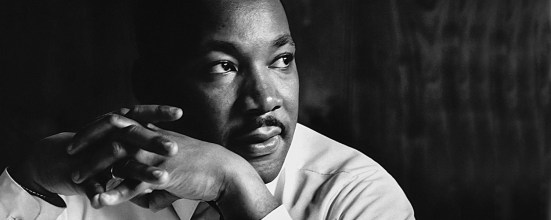
YouTube can provide many humorous examples of what I mean. “White People Visit a Black Church for the First Time” and “Unwritten Black Church Rules” are hilarious, yet surprisingly accurate. A life-long Baptist, I have attended both predominantly black and predominantly white churches and I can attest to the fact that there are real and very distinct differences. These differences are neither completely good nor completely bad and at the risk of sounding like Donald Trump after a White Nationalist rally, let me just say that “there are very fine traditions on both sides.” However, as much as we would like to think that the bounds of Christian love and understanding would be enough to bridge the cultural divide, this simply isn’t the case.
Take service length, for example. In the predominantly black church of my childhood, you had Sunday School from 9:30 to 10:30 A.M., morning service from 10:45 A.M. to 1:00 P.M. (1:30 if it was communion Sunday or if someone was being baptized), then a 3:30 afternoon service, Baptist Training Union (B.T.U) at 6:00 P.M. and evening service from 7:30 PM until about 10:00 P.M.  The first time I attended service at a white Baptist Church I was stunned when the 11:00 A.M. service, which included communion and the baptism of three people, ended promptly at 12:15 P.M. The congregation was lovely, the sermon inspiring, and the efficiency admirable (although as I arrived home at 12:30 with no afternoon or evening service ahead of me, I felt a bit like a fugitive at first, waiting nervously for lightning to strike me dead!).
I also like the casual sense of equality that prevails in the white church I now attend. Black churches tend to treat their clergy almost as royalty. I once attended a black church where, after the preacher finished his sermon, a “nurse” in full white uniform and cap came out and draped a “cape” around his shoulders – James Brown style! 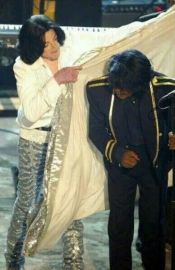 While men and women of the cloth undoubtedly deserve our respect, I just found the cape a bit too much!
Black churches also have a complex hierarchy, in which certain members are afforded special deference and command high levels of respect. The best example of this is the “Mother’s Board”, generally a group of elderly women who wield a frighteningly high level of social, if not actual power, while their genuine duties and the criteria for membership remain murky, at best. I have never found anything that is even approximately similar to the Mother’s Board in a white church and the congregants and pastor are happily on a first name basis.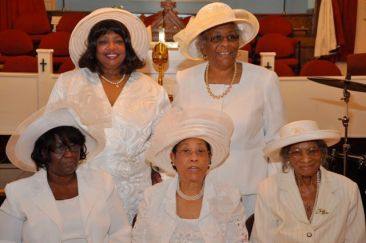
On the other hand, there are definitely aspects of the “black worship experience” that I sorely miss. While there are many supremely talented and classically trained musicians in the white congregation, even the peppiest praise songs just seem to lack that extra-special something best described as “soul.” The occasional handclapping in some white churches seems self-conscious and forced and foot-stomping, (a regular occurrence in black churches when the pianist will stop playing for a moment, letting the beat of everyone’s feet be heard and felt) is completely non-existent. “Black church” is far more participative and unscripted, from the call and response, meant to encourage the preacher through a sort of spiritual cheering squad, with exhortations of “Preach!”, “Amen!”, “All right now!”, (and my personal favorite) quite simply the word, “Well!” to people in the audience being so touched by the spirit of God that they “shout” or “get happy.” 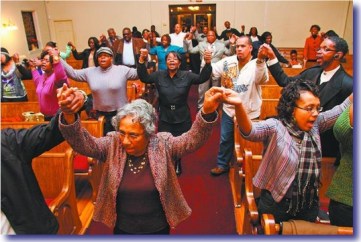 As a child I remember seeing one lady in our church get so “happy” that she shouted herself out of both her shoes and her wig! Moreover, the “Holy Ghost Dance” is an experience in and of itself. For an illustration, check out this “Holy Ghost mix” (some of the ladies in heels are truly impressive and the guy in the yellow pants who appears at 2:41 is truly a sight to behold). While I have no doubt that believers in the white community are no less devout, I have to confess that the quiet and lack of outward emotion in their worship was initially a bit unnerving to me.
Finally, there is the fashion. African Americans, by and large, love to “dress” and we were always taught that wearing your “Sunday best” was just another way of honoring God. I think the colorful, Steve Harvey inspired suits and the flamboyant “church lady hats” are a uniquely “black thing” that just give an air of specialness that seems appropriate when entering God’s house.  While I have occasionally worn slacks to my current church, I still have a hard time with the jeans and sneakers look. Additionally, even though I still think of myself as young enough not to dwell in the land of the “fuddy duddies” I came dangerously close to suffering an acute attack of “the vapors” the first time I saw white teenagers wearing shorts and t-shirts to Sunday service.
Neither of these styles is right nor wrong and there are pros and cons to each. I have no doubt that the love of God is universal and that many of our world’s current ills could definitely be, if not cured, at least somewhat alleviated if people of all faiths could join together in expressing compassion and caring to those around us; but there are some legitimate reasons why 11:00 A.M. on Sunday remains “the most segregated hour in America” and we don’t necessarily need to view that as a bad thing.
 quietlyradical