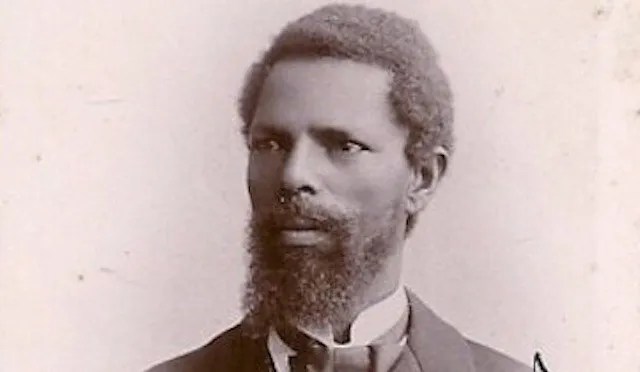
Onesimus – West African slave of clergyman Cotton Mather, who introduced the concept of innoculation to Boston after an outbreak of smallpox in the city in 1721.
Online dicussion forums, much like life itself, can sometimes involve many contradictions. Participating in these virtual public debates is often both informative and frustrating, eye opening and maddening, offering hope for the future while also, at times, being depressing as hell.
However, in honor of African-American History Month (which in itself is another entire category of debate), I’ve decided to share the story of Onesimus, a West African slave, who is also a lesson in contradictions. He effectively disproves the notion that black people have “never created anything of value in the United States”, (a belief that seems alarmingly common on Quora and other right wing websites) while also illustrating the shocking omissions from American history on the whole. His name itself, taken from the biblical story from the book of Philemon, is a vital component in the often complex relationships between slave and master in antiquity and its role in the complex evolution of race relations that has continued to this day. Most notably, however Onesimus, perhaps inadvertantly, kicked off the first “vax vs. anti-vax” debate, with none other than founding father, Benjamin Franklin.
Interestingly, the vaccination discussion on Quora, began in January of 2019, when news of the discovery of the novel Coronavirus, later dubbed “Covid-19” was barely a blip on anyone’s radar.
Blogger and health and wellness coach, Gina McGee, posed the following question:
When did people begin to question the safety of vaccinations and why?
Because this was pre-COVID, the question generated only a handful of views and just six answers. My own answer (which you can read on Quora, if you like), received only 16 views and 1 upvote. The other five were fairly predictable:
- 1 said that there are some who will always reject “anything new”
- The remaining 4 offered some variation of “vaccines are dangerous and bad” including the subplots of:
- There is a conspiracy among those in the medical field to hide the fact that vaccines are dangerous, and
- There are scientific reports which prove that vaccines are detrimental to everyone’s health. (As I read the CDC report which one of the respondents included as his “proof”, however, it quickly became evident that this person probably had not thoroughly read the report he was citing. Most of the deaths that had occurred in children who received the standard measles, mumps, diptheria, tetanus, and hepititis B vaccines were due to either allergic reactions to vaccine components or the fact that the children where already immuno-compromised as a result of some other serious health condition unrelated to the administration of the vaccines.)
The main problem, I believe, is that modern, anti-vaxer parents have no experiences with the childhood diseases that the MMR (measles-mumps-rubella) vaccines practically eliminated. With each passing year, fewer and fewer Baby Boomers are around to attest to the pre-vaccine horrors of polio. It is for this reason that perhaps the story of Benjamin Franklin, the slave Onesimus, and the smallpox vaccine might be more valuable to include in history lessons than the legend of Franklin flying a kite with a key attached in a lightning storm will ever be.
According to History.com, Onesimus was a West African slave purchased by the clergyman Cotton Mather (of Salem Witch Trial fame) in 1706. During a major smallpox epidemic which broke out Boston in 1716, Onesimus told Mather that he knew of a method to prevent smallpox that he had learned in his West African homeland. The “treatment” involved rubbing pus from a smallpox infected person into an open wound of a healthy person, thereby giving the healthy person a mild dose of the disease which built their immunity against further infection. Although skeptical at first, Mather shared the information with Dr. Zabdiel Boylston, who decided to try the process that Onesimus had described during another outbreak of smallpox in 1721. Dr. Boylston first used the method on his own slaves as well as his son. He then went on to innocuate 242 other Bostonians. There was only a 2% death rate among Dr. Boylston’s innoculated patients compared to a 14% death rate among the non-innoculated.
Benjamin Franklin was initially critical of the process and decided to forego innoculation for himself and his family. However, when Franklin’s four-year-old son died from smallpox in 1736, Franklin regretted his decision and became a proponent of innoculation for the rest of his life.
While no one can guarantee that every vaccination is 100% safe, it seems clear that vaccinations prevent more deaths than they cause. Sadly, however, by reaching the goal of eliminating many serious childhood diseases, we have also allowed society to effectively forget the physcial damage and loss of life that those diseases caused. My prayer for all of the anti-vaxer parents, is that they never have reason to regret their decision concerning the health of their children in the way that Benjamin Franklin did.
 quietlyradical