Always Define Your Terms
I’m sure that anyone out there who has studied Algebra is familiar with the maddening nature of word problems. You know the ones:
“The PTA Bake Sale raised a total of $177.50. Cookies were sold for 50 cents each and frosted cupcakes were $1.50 each. If the combined total of cookies and cupcakes sold was 95, how many cupcakes and how many cookies were sold?”
In our 13-year-old minds this would appear to be one of the world’s great unsolvable questions, but our teacher, Mr. Gil Hassler, would always remind us, “It’s not that hard. First, you just have to define your terms.”

In our politically polarized country today, I sometimes wish we had some sort of trusted political spokesperson, who like the late Mr. Hassler, would force all of us to “first, define our terms.”
Over the last 30+ years, starting with President Clinton’s proposed Health Care Plan of 1993, through the Affordable Care Act (ACA) signed into law by President Obama, through Democratic candidate Kamala Harris’ proposal to expand the ability of Medicare to negotiate the price prescription drugs, right-wing conservatives have denounced these schemes as “socialism”, or even, according to President Trump “communism.” However, if you stop the average red hat MAGA supporter on the street and ask them, “What is socialism?” “What is communism?” – most of them haven’t a clue. I would love to have a meaningful discussion with those on the right who oppose these types of social safety net program, but it is virtually impossible when we are working from completely different perspectives.
Even when I think my words are clear, sometimes other people still get things twisted. So, if you’ll allow me to channel my inner Ross Perot (I’m showing my age with that reference, I know. However, he’s an interesting character, so Google him if you’re curious) and rely on some charts.
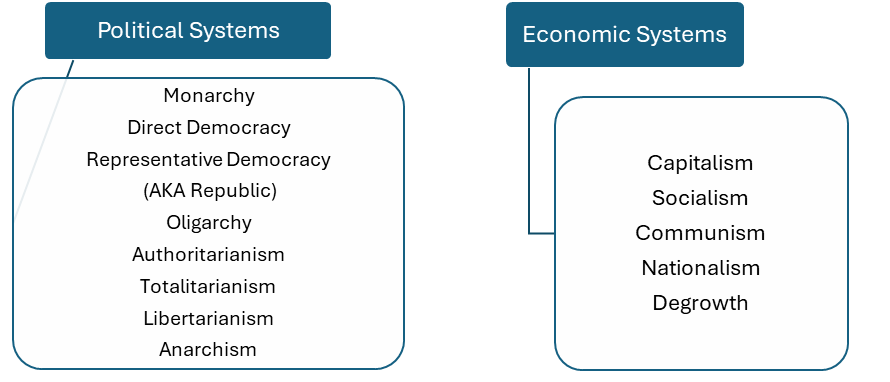
Countries generally operate under two systems at the same time: a political system and an economic system. Political systems relate to how the government is organized. Economic systems relate to production, commerce, and potentially, the distribution of wealth. What many people fail to understand is that political and economic systems can theoretically exist in a variety of combinations. For example, the United States has operated under the combination of a Representative Democracy (also known as a Republic) and free market capitalism. However, it could be possible to remain as a representative democracy politically but adopt some other economic system.
So, what are the actual definitions of these political and economic systems from which countries can “mix and match?”
Political Systems
Monarchy
- A single individual (king or queent) rules the country, usually for life
- Position is inherited
- Monarch may have actual power (King Salman bin Abdulaziz Al Saud of Saudi Arabia) or ceremonial power (King Charles III of the United Kingdom
Direct Democracy
- The citizens are not represented by any type of legislative body
- The people vote on rules and laws directly
- Ancient Greece is the best example of a direct democracy
- No modern countries currently operate under a 100% direct democracy model
Representative Democracy (aka Republic)
- Citizens elect representatives who establish rules and laws for them
- There are many countries today which operate under this model, including the United States where citizens elect senators and representatives at both the state and federal levels
Libertarianism
- Minimal government
- Strong protection of individual rights
- Personal and economic freedom
- The government’s role is to enforce contracts and provide for national defense and police services
- There are no fully Libertarian countries today
Anarchism
- An extreme form of libertarianism, where there is no central governmental authority
- Society should be organized voluntarily
- No true anarchist countries today
Oligarchy
- Power rests with a small number of people
- Oligarchs can rise to power through their wealth, religious affiliation, or military control
- Russia is an example of an oligarchy today
Authoritarianism
- Similar to an oligarchy in that power is concentrated in either one individual or a small group of people
- Citizens have limited rights and freedoms
- Focus is on order and obedience over individual rights
- Iran is an example of authoritarianism with power concentrated in the hands of Islamic leaders
Totalitarianism
- A centralized government which permits no individual freedom
- Citizens may be required to participate in approved public organizations
- Large-scale organized violence may be enacted toward citizens who don’t comply
- Afghanistan is an example of a totalitarian regime today
Economic Systems
Capitalism
- Private individuals or companies can own factories and land and operate businesses for a profit
- Prices are determined by supply and demand
- Competition in the market leads to innovation and economic growth
- The United States, Canada, and the UK are among many of the world’s capitalist nations today
Socialism
- Individuals do not own property and natural resources; society as a whole either owns or controls property and the means of production which all citizens share
- Socialism promotes cooperation among citizens and prevents income inequality
- Greece, El Salvador, and Ecuador are examples of countries which practice socialism today
Communism
- System in which the government owns land, factories, and businesses
- Goal is to have equal access to food, housing, and healthcare for all citizens
- Social classes are eliminated; no one is considered rich or poor
- Cuba, North Korea, and Vietnam are examples of communist countries today
Nationalism
- Prioritizes a nation’s own economy over the global economy
- Advocates for protecting domestic industries from foreign competition
- Economy should strengthen the nation’s economic independence and military power
- North Korea is the best example of an almost completely nationalistic society today
Degrowth
- Promotes reducing levels of production and consumption to conserve natural resources and minimize environmental damage
- Promotes recycling and reusing existing products to reduce the need for unnecessary production
- Focus on renewable energy and “green jobs”
- There are no countries that follow the degrowth system completely, although there are several European countries that are experimenting with a degrowth system in certain industries
The problem, it seems to me, is that for many Americans, communism and socialism are synonymous with authoritarianism or totalitarianism. As a result, without a clear definition of terms, many U. S. citizens also tend to believe that the representative democracy that the United States has enjoyed is only possible when paired with capitalism. However, this is simply not the case.
For example, when many Americans think of communism, they automatically think of China, Russia, Cuba, North Korea, and Vietnam . From the American perspective, the citizens of these countries don’t enjoy the same freedoms as citizens of the U.S. do. While this is true, generally speaking, the lack of freedom isn’t the result of the economic system of communism. The lack of freedom is more closely associated with the political systems which control these countries.
Each of these countries can provide fitting examples of the “mix-and-match” nature of politics and economic systems. Take China’s Xi Jinping, self-appointed president for life, for example. President Xi could best be described as the head of an authoritarian government. However, from an economic perspective, China continues to move away from communism and closer to capitalism. From a political perspective, Russia is an oligarchy. However, they are also moving away from a communist economic model toward a more capitalistic society.
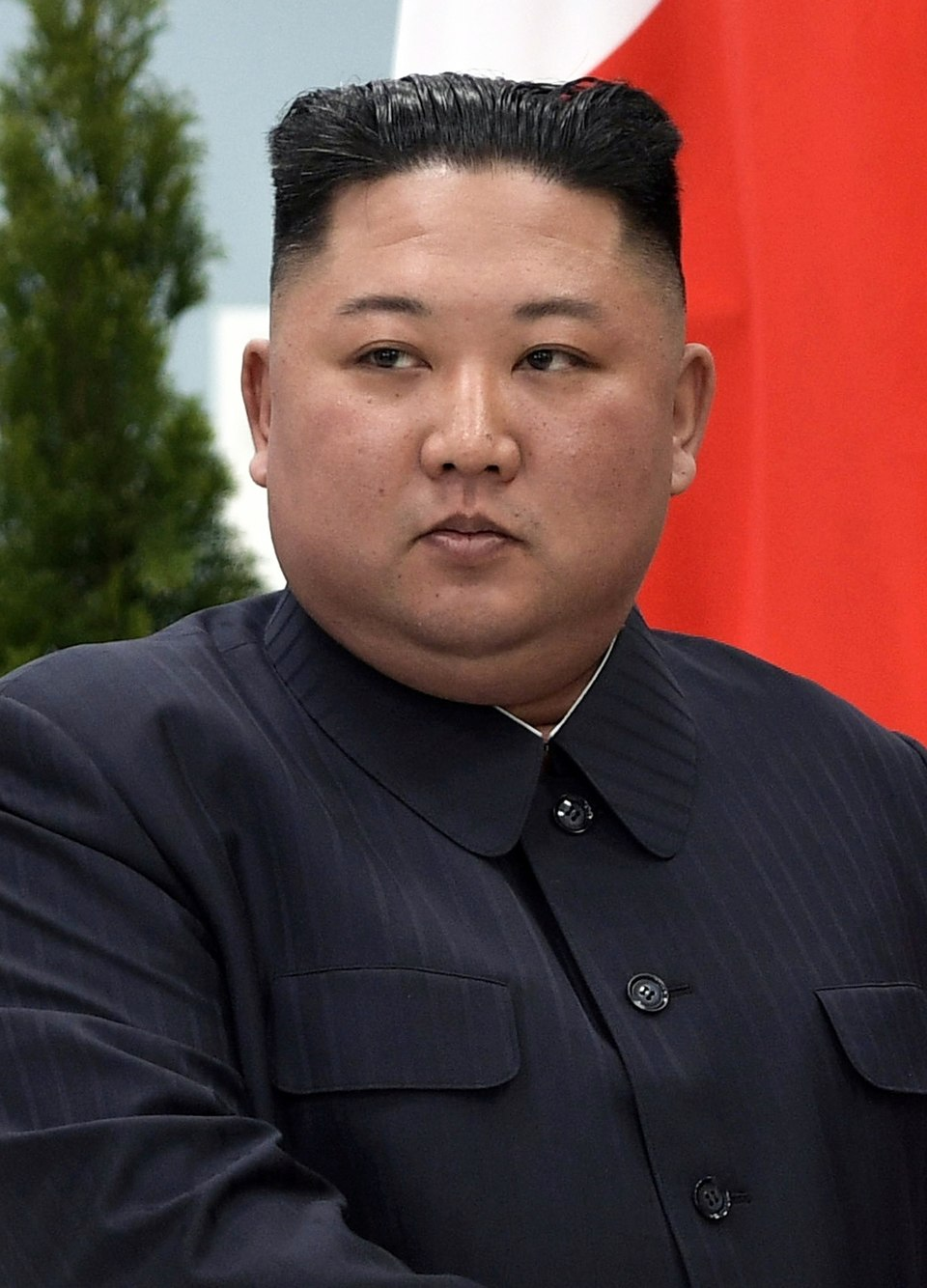
Cuba’s economy is based on socialism but the lack of respect for human rights is the result of having been governed by a series of totalitarian dictators (Fidel and Raul Castro and Miguel Diaz-Canal. North Korea employs an economic system based on nationalism, but the extreme limitations on personal freedom can be attributed to the totalitarian leadership of Kim Jong Un and his predecessors. There are also countries such as France, Sweden, and the United Kingdom where the citizens enjoy personal freedom under government systems which are representative democracies but have strong elements of socialism in their economic systems.
Unfortunately, the lack of a clearly defined set of terms led roughly half of U.S. voters to choose Donald Trump over Kamala Harris in the 2024 Presidential election because Trump painted Harris as either a socialist or a communist and the Make America Great Again (MAGA) base interpreted this as meaning that a President Kamala Harris would take away personal freedom. What is ironic, however, is that of the two candidates, it was Harris who more strongly supported America’s representative democracy as outlined in the U.S. Constitution.

It is Trump, who openly associates with oligarchs such as Elon Musk, Peter Thiel, Jeff Bezos, and Mark Zuckerberg, while also embracing the ideals of authoritarianism as he attempts to muzzle the press, seek vengeance on his political enemies, and rule by executive order rather than through the standard legislative process, who poses the greatest threat to personal freedom.
Furthermore, engaging in a nearly worldwide trade war and pushing the idea that the United States should bring manufacturing back to our own country is, instead of strengthening the U. S. economy, actually causing the U. S. to move away from capitalism toward nationalism. Unfortunately, many in the MAGA movement cheer this on, without really understanding what the term “nationalism” means.
So, perhaps instead of debating the pros and cons of Trump’s approach, we first need, somehow, convince Americans that being a “one-issue” voter simply doesn’t make sense anymore.
Finally, I have to confess that as a thirteen-year-old Algebra I student, I often wondered whether Algebra was something that I would use in my adult life. Now I realize that Mr. Hassler was on to something brilliant – the problems aren’t that hard IF you correctly define your terms.
 quietlyradical