“Flip-Flopping” or Simply an Evolving Point of View?
In the world of politics, facing accusations of being a “flip-flopper” is often the kiss of death for a potential candidate. Back in 2000, when then Vice-President Al Gore launched a campaign to be the successor to President Bill Clinton, many believe that Gore’s change of direction on certain key issues was a negative factor which should disqualify him from the presidency. Earlier in his congressional career, Gore, despite being a Democrat, (Hook, 2000) on issues involving union rights, gun control, federal funding for abortions, and environmentalism. Gore was criticized for adopting a more liberal stance on these issues during his presidential campaign.
More recently, former Vice-President Kamala Harris faced similar criticism for changing her stance on issues such as fracking, expanding the border wall, and Medicare for All (Thompson, 2024). While some seem to believe that voters should be suspicious of a change in stance, I would argue that demonstrating the ability to change one’s position in the face of new information is a positive trait, rather than a negative one.
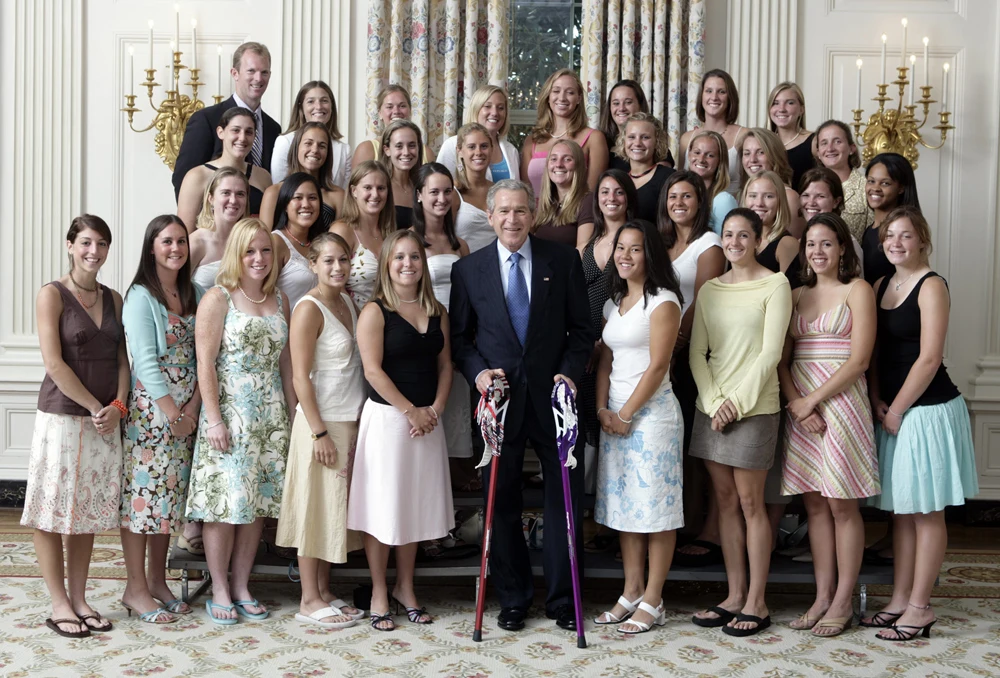
During George W. Bush’s presidency, there was even a controversy over actual flip-flops (the comfortable footwear.) Members of Northwestern University Women’s Lacrosse team were photographed with the POTUS at the White House in 2005, and the country was deeptly divided over the fact that four of the young women in the front row chose to accessorize their lovely summer dresses and skirts with footwear normally seen at the beach.
First of all, I think that voters, especially during presidential campaigns, forget that the United States is a republic, also known as a representative democracy, in which members of the House of Representatives are charged with fulfilling the desires of the majority of voters in their congressional districts, while senator and governors, on the other hand, are charged with representing the views of the constituents of their individual states. As a member of the House in a highly conversative district in Tennessee, Gore’s voting record reflected the pro-life, pro-gun, anti-environmental legislation that his constituents demanded. As a senator, however, Gore needed to consider the concerns of the entire state of Tennessee. Although, rural Tennessee remained highly conservative, growth in the metropolitan areas like Nashville, Knoxville, Chattanooga, and Memphis meant that Gore’s constituency had expanded. Residents moving to these cities from more liberal areas also would expect to have their interests and concerns addressed. So, rather than being seen as a sign of indecisiveness, a politician’s change in stance could actually be their response to the changing needs and concerns of a more diverse constituency.
Candidates for the office of President of the United States (POTUS) face an even greater challenge, as they must shift from representing the concerns of their home states, to adopting stances that will be palatable to all citizens. The best leaders should seek to find some middle ground in which the needs and concerns of all citizens are considered equally. This could not be accomplished by stubbornly clinging to a rigid personal stance, no matter what the citizens desire.
Second, not only does a politician’s constituency change over time, but the facts surrounding a specific issue may change as well. V. P. Kamala Harris was severely criticized for first opposing fracking, (Energy4Me) the process by which natural gas is collected from deep within layers of rock by using a combination of highly pressurized water and chemicals to fracture the rock and release the gas, and then later supporting it. Initially, however, fracking carried a number of risks, such as contamination of groundwater and air pollution (National Institute of Environmental Health Sciences) so opposition to it, especially in Harris’s environmentally conscious home state of California, would be completely reasonable. However, once Harris began seeking the presidency her position could no longer support the needs and concerns of California alone. The fracking industry provides jobs and allows the U.S. to have a source of low-cost energy that can be used while renewable energy sources are being developed. Additionally, fracking technology continues to improve, meaning that the threats that it poses to the contamination of water and air are being steadily reduced. If Harris had continued opposing fracking simply in order to avoid being labeled as a “flip-flopper,” such stubbornness and resistance to change would not have been in the best interest of the American people.
Additionally, from my point of view actual “flip-flopping” is much different than allowing opinions and beliefs to evolve over time as new information is uncovered. True flip-floppers have no solid, well-considered reasons for changing their position; they are simply pandering to what they believe that their audience wants to hear in the moment. Conversely, psychologists suggest that being open to new ideas, possessing healthy skepticism for “easy” solutions, and having the ability to adapt according to changing conditions if the mark of a highly intelligent individual (Ten Signs of Intelligent People, 2023).
Changing one’s mind and challenging the status quo isn’t easy and is not without risks, especially when those around us are resistant to change for a wide variety of reasons. The average American likely has a fear of the unknown, combined, perhaps, with an emotional attachment to the past. However, this mindset is not in our best interest. As Philip Dow, author of Virtuous Minds said, “…if we are not courageous thinkers, we are unlikely to be truly honest thinkers” (Dow, 2013). Thanks to technology, the discovery of new information occurs today at breakneck speeds. If we are to keep pace with our rapidly changing world, it is imperative that we embrace the idea that the positions and beliefs that we hold today may very well become obsolete in the not-too-distant future. As a result, the ability to alter our perspective as quickly as possible could be the key to survival.
Works Cited
Dow, P. E. (2013). Virtuous Minds. InterVarsity Press.
Energy4Me. (n.d.). Hydraulic Fracking Technology. Retrieved May 14, 2025, from https://energy4me.org/learn-about-energy/technology/hydraulic-fracturing-technology/#:~:text=The%20search%20for%20increased%20access,natural%20gas%20throughout%20the%20world.
Hook, J. (2000, March 6). Gore’s Voting Record: Flip-Flops or Evolution? Los Angeles Times.
National Institute of Environmental Health Sciences. (n.d.). Hydraulic Fracturing and Health. Retrieved May 14, 2025, from https://www.niehs.nih.gov/health/topics/agents/fracking
Ten Signs of Intelligent People. (2023, December 26). Psychologs Magazine.
Thompson, A. N. (2024, August 27). Harris Flip-Flops on Building the Border Wall. Axios.
 quietlyradical