The H1B Visa – it’s hard to believe that it has been only about eight months since Elon Musk’s controversial remarks regarding this program in the United States were generating outrage and dominating the news cycle. I think that this is perhaps why life seems so overwhelming at times; we never really bring one controversy to a satisfactory conclusion before we are off and running with the latest shocking revelations. “How quickly we forget” used to refer to topics which faded from our collective memories within a few years of their origination. Now that timeline has been reduced to months, weeks, and in some extreme cases, mere hours. So, while this topic will undoubtedly feel like “old news” to many, perhaps if start thinking more deeply about some of the unresolved issues of the recent past, the “Chicken Little Syndrome” of believing that the sky is falling with the most recent bit of chaos to which we are constantly exposed, we can begin to understand the underlying causes of the communal unease that we share as Americans. Instead of focusing so much on “what” is going on in the moment, shouldn’t we perhaps begin focusing on “why” this is upsetting us? From my days as an Information Technology (IT) service analyst, identifying the root cause was generally the most effective method of fixing whatever glitch had appeared, no matter how complex the overall system.
So, what is the H1B Visa? As part of the Bush, Sr. Administration’s Immigration Act of 1990, it was a program “aimed to give U.S. employers a legal, regulated way to hire skilled foreign professionals to fill shortages in specialty occupations” (ChatGPT, 2025). I had my first encounter with HB1 Visa employees in 2006. I was working as a service analyst in the IT department of a larger U.S. insurance company, and I began to notice a large influx of employees from India, especially in software development roles. What struck me as odd and somewhat problematic was that I quickly learned that these individuals were not full-fledged company employees. They were identified by a different color on their security badges, did not receive any company benefits, and were even denied company perks such as being granted membership in the employee activities association. This meant that they couldn’t have access to the employee park with its swimming pool, tennis courts, summer day camp program for their children, and discounted health club memberships, among other things.
Some of the “regular employees” showed hostility toward these workers, claiming that they were “taking jobs away from Americans.” Others of us, however, found the covert “second class citizen” status of these colleagues quite disturbing. On the surface our company practiced something known as “Good Neighbor Nice,” but underneath I couldn’t help but feel that these folks were being exploited in the name of maximizing profit for the company. In the 20 years since my personal experience with H1B visa employees, little has changed. But rather than simply continuing to either lament the shortage of skilled U.S. workers or complain about immigrants suppressing wages and taking jobs away from native born Americans, could we instead dive into the underlying causes of these problems in order to seek real solutions?
First, is there really a shortage of highly skilled workers in certain fields? The short answer appears to be, “Yes” and so the next logical question is, “Why?” According to Charlotte Hu and Amanda Downie of IBM, one of the biggest reasons is the speed at which technological advances are made today. Hu and Downie cite U.S. Bureau of Labor Statistics data which indicates that, “Over the next ten years, tech jobs are projected to grow at twice the rate of the overage U.S. workforce” (Hu & Downie, 2024). Reviewing the factors which are contributing to this accelerated growth could be the key to finding better solutions.
Rapid Technological Evolution
With the advent of new technologies in the areas of artificial intelligence (AI) and machine learning (ML), technological advancements are occurring much more rapidly than they did in the past. In the 1980s computer hardware options were limited and a person graduating with a computer science degree in the mid-1980s could rely on their skills remaining relevant for at least a decade. Today, it is estimated that the half-life of skill relevancy for a computer science major today is four years at best and growing shorter all the time.
Increased Competition for Talent
From 1980 to around 2000, the transition to computer-based operations was fairly slow at first. Today, however, even the smallest companies will require relatively high levels of technological expertise in order to remain competitive in today’s environment. As a result, there is increasing competition among employers for job candidates with the necessary skills.
Outdated Educational Practices
With the lifespan of skill relevancy being reduced to four years, candidates who pursue four-year university degrees in tech run the risk of the skills they have learned at the beginning of their university careers already being on the way to extinction by the time they graduate.
Outdated Recruitment and Hiring Practices
Larger organizations and companies in established industries such as insurance, banking, and retail may be stuck in the past in terms of recruitment and hiring. The old hiring model generally involved participating in university job fairs before the end of fall and spring semesters. Then the candidate might have to undergo a screening interview and perhaps an assessment of their basic skills with a representative from Human Resources (HR).
Next, there may be an interview with the hiring manager and then a background check and job offer, followed by a pre-boarding and/or onboarding process. By the time all these steps have been completed as many as four or five months may have elapsed since the initial contact between candidates and the employer. In a fast-paced and highly competitive environment, companies who continue to follow this hiring model will almost always lose access to the highest quality candidates to companies who have a streamlined hiring process.
Outdated Corporate Culture
Companies who cling to an old-fashioned, top-down hierarchy and who don’t believe in increasing non-monetary corporate perks will also have difficulty in recruiting top U.S. talent. One example is offering flexibility in terms of offering fully remote or hybrid work models rather than forcing all employees to work onsite. Today’s employees generally want the option to either work from home or not to achieve a better work-life balance.
Companies such as Google, Microsoft, Apple, and Salesforce who are famous for attracting and retaining top talent not only offer highly competitive salaries and perks like casual dress, free lattes, or the ability of employees to bring their dogs to work, they also focus giving employees interesting and challenging work, encouraging employee input and actively implementing employee ideas, and giving employees as much autonomy as possible. Ensuring that the work itself provides as many intrinsic rewards as possible is probably equally as important as the monetary benefits.
Misconceptions About H1B Visa Workers
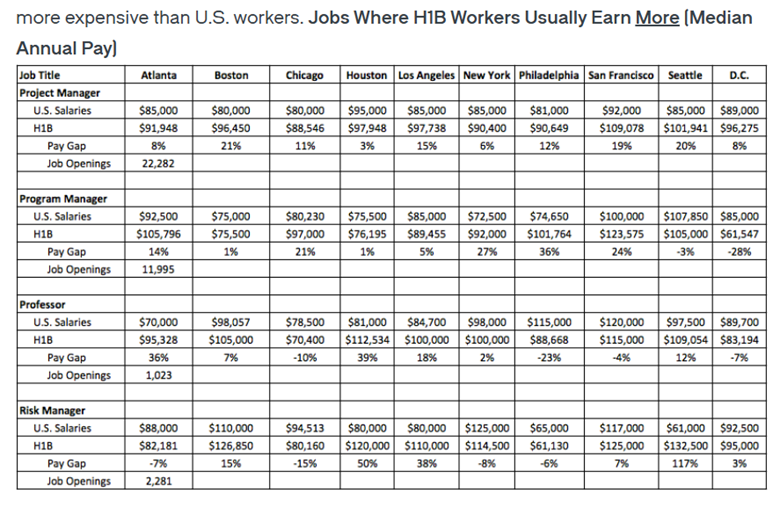
One of the most widely held misconceptions about why employers rely on H1B Visa employees is the idea that these employees are paid significantly less than American workers and are therefore a threat to wages and job growth. However, according to the National Bureau of Economic Research, salaries for H1B Visa holders are not substantially different from those of U.S. employees and in certain positions such as project managers, program managers, and risk managers the H1B workers’ salaries are actually higher than those of American workers in similar positions (Chamberlain, 2017)
How To Solve the Problem
If the ultimate goal of the United States is to fill the tech worker shortage without relying heavily on H1B workers, then perhaps we should look at how India and China, the two largest sources of skilled STEM workers have developed such an extensive skilled workforce.
Facing Difficult Truths
Entrepreneur and politician Vivek Ramaswamy caused a major stir with his December 2024 post on X where he suggested that American culture doesn’t prioritize academic excellence. Ramaswamy angered many, especially in the Make America Great Again (MAGA) wing of the Republican party when he wrote, “Our American culture has venerated mediocrity over excellence for far too long…A culture that celebrates the prom queen over the math Olympiad champ, or the jock over the class valedictorian, will not produce the best engineers.”
As harsh as Ramaswamy’s words may have sounded, he wasn’t wrong. After retiring from a job in corporate American I launched a second career in education. I’ve spent the last decade as a private tutor and there is a marked difference in the levels of commitment to academics between Asian and American students.
In 2011, after obtaining a master’s degree in education, I left my job in Corporate America to establish my own private tutoring service. While building my own business, I worked as a tutor for Eye Level Learning an after school learning center which focused on helping students excel in math and English. What I found most interesting, was that even though this center was located in a medium-sized city in central Illinois, all of the students who came to the center were the children of Chinese or Indian immigrants. Children as young as five were coming in after school and on Saturdays to study math and reading. Many were preparing for the Scripps National Spelling Bee, the Mathletes program, or participating in chess tournaments. The dedication of both the students and their parents was at a level that I rarely saw in my native-born American students.
In the United States, Friday night football and high school basketball is often celebrated throughout the entire community. While there is nothing inherently bad in this support, it does offer some insight into why students in other countries are outperforming their American counterparts.
While the Trump Administration is planning to sharply reduce funding to the Department of Education, the Chinese and Indian governments are investing more money in education. Universities in China and India are highly subsidized by the national government. This allows even students from poor families to have the opportunity for a university education, unlike in the U.S. where higher education for all except the extremely wealthy is becoming cost prohibitive.
Young American students (and sometimes their parents as well) often see material possessions, social popularity, or athletic prowess as the most important markers of status and success. Conversely, other countries view education as the key to upward mobility.
If the United States wants to reduce its reliance on H1B Visa holders, there must be a dramatic shift in our priorities as a nation. Banning books is not the answer. Eliminating the Department of Education is not the answer. Continuing our disproportionate focus on sports programs and the ongoing debate about whether trans athletes should be allowed to compete is definitely not the answer. Until parents, schools, and government are willing to join forces to press for academic excellence in our students, we will never be able to fill the growing need for highly skilled tech professionals from within our current population. Rather than simply being offended by remarks like those of Vivek Ramaswamy, why don’t we take the necessary steps to prove him wrong?
Works Cited
Chamberlain, A. ( 2017, March 27). Dispelling Myths: What HB1 Visa Workers ARe Really Paid. Retrieved September 14, 2025, from https://www.glassdoor.com/blog/h1b-workers/
ChatGPT. (2025, September 14).
Hu, C., & Downie, A. (2024, October 3). Why Is Tehre a Shortage of Tech Talent? Retrieved September 14, 2025, from https://www.ibm.com/mx-es/think/insights/tech-talent-shortage
Shuo, Z. (2025, July 16). China Ranks 2nd in STEM Education. China Daily.
 quietlyradical