Have you ever noticed how sometimes an attempt to fix one problem can set off an entire series of unintended (and often unpleasant) consequences which we never anticipated? The first example which comes to mind was during my career as an insurance industry business analyst. When a state insurance commission required our sales agents to provide more coverage details on the homeowner’s insurance premium quotes provided to customers, part of my job was to work with our Information Technology (IT) partners to make that happen. The initial solution resulted in 2-page quote sheet, and while the insurance commission was satisfied, the sales agents were not. More pages meant greater expenses – in the form of more paper and printer ink, staples, and increased postage when quote sheets were mailed. (This was in1994 at a company which had been in business since 1922. “Snail mail” was definitely still a thing and fax machines were still considered “too cutting edge” for some of our older sales associates.).
So, to fix this problem, we came up with the idea of reducing the font size, which solved the 2-page problem, but sparked outrage from the customers, who became suspicious that we were trying to “hide something in the small print.” What about adjusting the page margins? This sparked another mini-revolution among the sales agents. The adjusted margins meant that they could no longer use the seasonal stationary with autumn leaves or holiday greenery adorning the borders of the page. Ok, let’s just shrink the customer’s name and address information and move it from a prominent place on the page to the stop left corner. “No!” the agents screamed. “The placement of the name and address where it is allows us to fold the quote sheet and place it in a window envelope (the snail mail issue again). Without that our staff members will need to address the envelopes by hand!” (Time is money and you can’t risk the “girls” in the office getting carpal tunnel syndrome, don’t cha know.)
Ultimately, after an intervention which escalated all the way up to the Executive Vice-President of Agency we ended up right back at our original solution, appeasing the agents with the promise that their state would be the first to receive the new Agency Workstations which could allow quote sheets to be sent as email attachments.
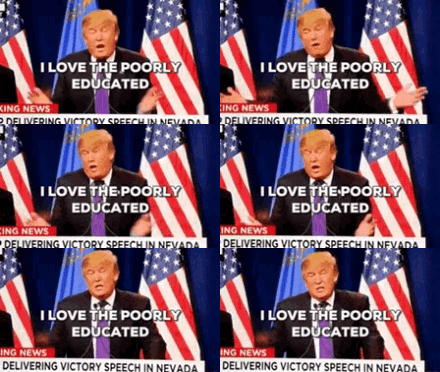
Fast forward to February 2016 when Politico reported on Donald Trump’s remarks following his victory during the Nevada Caucus. While thanking his supporters Trump said, “We won with highly educated. We won with poorly educated. I love the poorly educated. We’re the smartest people, we’re the most loyal people” (Politico, 2016). Little did we know that this throwaway line by the ultimate con artist would result in a long “series of unfortunate events” for the United States the world which even Lemony Snicket [i]would find hard to swallow.
After his first inauguration in 2017, began issuing a slew of Executive Orders, many of which touched off a domino effect of negative consequences. The “Muslim Travel Ban” is one example. Issued under the guise of protecting the United States from so-called “terrorists” by placing a 90-day ban on travel from Iran, Iraq, Libya, Somalia, Sudan, Syria, and Yemen and prohibiting resettlement of Syrian refugees it actually resulted in Muslim-Americans who had gone to visit family members in their home countries being temporarily stranded, unable to return to their homes in the United States. Islamophobia in the U. S. increased with Muslim Americans suffering emotional and psychological stress from the hate and bigotry aimed in their direction from “poorly educated” Trumpers, no longer ashamed to showcase their racism and xenophobia in full view. U.S. universities suffered as applications from international students dropped sharply as Trump’s posturing signaled that the United States was not welcoming to individuals who were not white, Christian, and male. Republican Senators John McCain and Lyndsey Graham also cautioned that the ban could actually have the opposite effect in terms of reducing terrorism. They warned that terrorist organizations would interpret the ban as a prime example of the U.S. hostility toward Muslim nations and use it as a recruiting tool.
The administration’s disdain for science as a major factor in the mishandling of the COVID-19 pandemic, resulting the deaths of more than 1.2 million Americans and the permanent closure of more than 200,000 U.S. small businesses.
Despite the brief respite from complete and utter chaos afforded to the nation by Joe Biden’s election in 2020, sadly, the poorly educated also seem to be plagued by short memories and a willingness to accept Trump’s blatant lies at face value. Now, in 2025, not even a full year into Trump’s second term, we find ourselves in even worse shape than before the pandemic. Trump’s nonsensical trade war and the deportation of essential farm and food processing factor workers have resulted in drastic increases in prices of consumer goods. The last available USDA report (more current statistics are not available as a result of the current government shutdown), indicates that the prices of meat, poultry, fish, and eggs are up 5.2% since September 2024 (Stewart & Dong, 2025).
Trump’s harsh immigration policies have reduced illegal border crossings; however, they have also had the unintended effect of damaging international tourism to the United States. According to Newsweek, a forecast by the U.S. Travel Association projects a 6.3% decrease in international visitors to the United States throughout the remainder of 2025 and into 2026 (Kim, 2025). While the political climate may be keeping foreign tourists away, inflation, job uncertainty, and concerns about the safety of airline travel resulting from air traffic controllers and TSA agents being forced to work without pay due to the government shutdown will likely have a negative impact on domestic travel as well. Hotels, restaurants, rental car companies, tourist attractions, shopping centers, and other entertainment venue will all take a hit.
As disheartening as these impacts are, perhaps the most problematic for the future of our country are the President’s efforts to not only express his appreciation for the poorly educated but also his apparent desire to expand their ranks. A research project conducted by Northwestern University, suggests that IQ scores in the United States are, indeed, falling. Data analysis of IQ scores for nearly 400,000 Americans over a twelve year period have shown significant drop in IQ scores in for specific areas:
- Verbal Reasoning: Logic and vocabulary
- Matrix Reasoning: Solving visual problems
- Series of Letters and Numbers: Mathematics and computing
- Verbal Memory: Word recall (Carvalho, 2024)
While the complete explanation for the decline is multi-faceted, the study pointed to factors such as poor nutrition, deterioration of health, and changes in the education system as likely contributing factors. Currently the Trump Administration’s policies pose major threats to SNAP, WIC, and free and reduced lunches which directly impact nutrition. Quality of healthcare in the United States is at risk as a result of cuts to Medicaid, the reversal of the Biden Administration’s caps on the cost of prescription drugs and attempts to defund the Affordable Care Act. Dismantling the Department of Education, gutting early learning programs, and implementing book bans, will clearly do nothing to reduce the downhill slide in IQ points.
Finally, as the administration discontinues important research funding American scientists are being actively recruited by other countries. According to the Global Health Technologies Coalition, the European Union has pledged $567 million over three years to make Europe a magnet for U.S. researchers (Reiling, 2025). In France, Aix-Marseille University has received 300 applications from Americans for its “Safe Place for Science” program, many foreign scientists and researchers are considering returning to their home countries and those who were planning to enter PhD programs in the United States have now decided to study elsewhere (Benson, 2025).
Disillusionment can often be the catalyst for life-altering changes. I know this from personal experience – disillusioned with life in corporate America, I returned to university for a master’s degree in education and embarked on a new career teaching English as a Second Language in 2012. My students are curious and entertained by American idioms and slang. “Who’d a thunk it?” the informal slang expression for “who would have thought it?” which is used to show surprise at an unexpected outcome is one that they often find especially entertaining. When Donald Trump declared that he “loved the poorly educated” back in 2016, the country would have no way of knowing the long-term repercussions of that statement. If the impacts weren’t so dire, the “Who’d a thunk it?” expression might be apropos. However, in a time where economic damage, climate change, and a host of other challenges conspire to make life in this country more difficult than it has ever been, the brain drain plaguing the U.S. could not have come at a worse time.
References
(2016, February 24). Retrieved from Politico: https://www.politico.com/video/2016/02/donald-trump-i-love-the-poorly-educated-044575
Benson, T. (2025, April 24). Brain Drain: Scientists Are Fleeing the U.S. As Trump Cuts Funding. Rolling Stone. Retrieved November 7, 2025, from https://www.rollingstone.com/politics/politics-features/scientists-fleeing-america-trump-cuts-funding-jobs-1235324006/
Carvalho, F. L. (2024, December 20). Are Americans Getting Dumb? First of Its Kind Study Shows Alarming IQ Decline in 4 of 5 Areas. Retrieved from CPG: https://en.clickpetroleoegas.com.br/Americans-are-getting-dumber%2C-new-study-shows-alarming-decline-in-IQ-in-4-of-5-areas/#:~:text=A%20first%2Dof%2Dits%2Dkind%20study%20has%20revealed%20a,about%20the%20country’s%20intellectual%20future.
Kim, S. (2025, October 8). Warning as Decline in Tourism to US Risks Thousands of Jobs: Experts. Newsweek. Retrieved November 7, 2025, from https://www.newsweek.com/experts-warning-international-tourism-decline-us-risks-job-loss-10847558
Moon, T. (2016, November 9). US Election: Climate Scientists React to Donald Trump’s Victory. (C. B. Reported, Interviewer) Retrieved November 7, 2025, from https://www.carbonbrief.org/us-election-climate-scientists-react-donald-trumps-victory/
Reiling, A. (2025, September 30). The American Brain Drain: How a US Retreat from Research is Driving Innovators Abroad. Retrieved November 7, 2025, from Global Health Technologies Coalition: https://www.ghtcoalition.org/blog/the-american-brain-drain-how-a-us-retreat-from-research-is-driving-innovators-abroad
Stewart, H., & Dong, D. (2025). Food Price Outlook – Summary Findings. USDA Economic Research Service. Retrieved November 7, 2025, from https://www.ers.usda.gov/data-products/food-price-outlook/summary-findings#:~:text=From%20July%202025%20to%20August%202025%2C%20retail%20egg%20prices%20decreased,layer%20flocks%20and%20egg%20production.
[i] Lemony Snicket is the pen name for American author Daniel Handler, and he is also the fictional narrator of the popular book series A Series of Unfortunate Events. As the author, Handler writes children’s books, including the A Series of Unfortunate Events series, under this pseudonym. As the narrator, Snicket investigates and recounts the tragic story of the Baudelaire orphans.
 quietlyradical