What the Cold War Taught Me—and What It Got Wrong
1972 was an interesting year to be a third grader in the United States. Although it didn’t occur to me at the time, it now seems as if our class spent an awful lot of time watching television. It started with the 1972 Winter Olympic Games in Sapporo, Japan. Our teacher, Miss Janet Raines, wheeled in the giant cart containing an old school, black and white TV and we watched 16-year-old Izumi Tsujimura as she skated into the arena bearing the Olympic torch and then passed it off to Hideki Takada, another 16-year-old Japanese student who ran up the steps to light the cauldron.

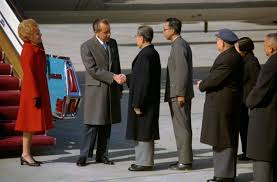
A few weeks later the TV was wheeled in again so that we could watch President Nixon visit The People’s Republic of China which our parents and grandparents still referred to as Red China. The tour of The Great Wall of China was impressive and the gift of the two giant pandas, Ling-Ling and Hsing-Hsing was pretty exciting for a group of 8- and 9-year-olds, the larger significance of the visit was likely completely lost on us.
In the spring we watched the astronauts of Apollo 16 spend a few days driving around the surface of the moon in their lunar rover. While the first moon landing just 3 years before had riveted the world, by now the excitement had dulled a bit, even for elementary school students. After all, it seemed pretty clear that there wasn’t much to see on the moon and how many more moon rocks and soil samples did NASA actually need?
Finally, in late May, just before the start of summer break, we watched as President and Mrs. Nixon traveled “behind the Iron Curtain” (I was actually kind of disappointed that this was just a figure of speech – I remember thinking that an actual Iron Curtain would have been even cooler than the Great Wall of China, the giant pandas, and the moon rocks combined!) where they were wined and dined and treated to an evening at the Bolshoi Ballet by the Soviets in Moscow.
However, the underlying theme was that while the Chinese and the Soviets were the consummate hosts, the everyday, run-of-the-mill citizens did not enjoy the freedom or the quality of life that we did here in ‘Murica. While it would be a few more years until our social studies lessons began to include references to communism and socialism, I could glean enough information from watching Walter Cronkite with my parents every night to understand that socialism was “bad” and communism was worse (after all, wasn’t that what the whole ugly Vietnam business was about – stopping the spread of evil, awful communism?).
Curiously, it wasn’t until I was much older that the term “capitalism” came into play. When talking about the United States it was always framed that we had freedom specifically because we didn’t have communism and socialism. Now, however, I’ve come to the realization that capitalism and freedom are two vastly different things and there are plenty of countries in the world that operate under a socialist economic system while also enjoying even greater freedom than we have in the United States today.
By grade 8 we were studying the Declaration of Independence and the U.S. Constitution, and while I could clearly connect the dots as to the idea that other countries didn’t necessarily have all of the freedoms that we enjoyed under the Bill of Rights (speech, religion, assembly, etc., etc., etc.) it was never made clear that those legal rights were separate and apart from the capitalist economic system. The concept of democratic socialism was somehow left out of the picture. I knew that the countries of Sweden, and Norway, Denmark, and Finland existed, but I don’t ever recall studying their economic systems in any great detail.
As a Black American growing up in the 1970s, I also knew, deep down, that at least some of the hype about the supposed greatness of the U.S. was clearly hype, especially for people who looked like me. I could clearly see the ugly scar on my father’s foot where he had been burned while working in a non-union iron foundry before I was born. Later, after having backed the successful mayoral candidate in our small Indiana town, Dad escaped the sweat shop conditions of the foundry and became a city firefighter. However, the firehouses in our town remained segregated for a full 14 years after the passage of the Civil Rights Act.
There were poor people, of all races in our town, despite it being located in the “richest country in the world.” I also remember watching Walter Cronkite once again reporting on the horrific violence visited upon black school children in Boston when forced busing came into play. I watched women burning their bras and struggling and ultimately failing to get the equal rights amendment passed. I even looked on helplessly as the young boys in my elementary school class displayed disturbing levels of misogyny toward me and the other girls that generally went unpunished so long as they didn’t “put their hands on us.”
I entered the workforce in 1985, during a brief “golden era” where women and minorities were beginning to enjoy equal opportunities in the workplace. My company still offered generous health insurance benefits, a pension plan, and a 401K company matching program. Luckily, I was always able build wealth through homeownership, even after a divorce. Sadly, however, around 2000, this golden age gradually began to come to an end, and when I no longer enjoyed the work itself and dreamed of changing careers, I found myself trapped by the “golden handcuffs” of health insurance. It wasn’t until after the passage of the Affordable Care Act (aka Obamacare) that I was truly free to leave my corporate job and pursue work that fed my soul if not my pocketbook.
My dream job involved teaching English as a second language, however, I sometimes think that I learned much more from my students about how the United States really works than they ever learned from me. I had a Russian student who worked for a medical supply company. My mother was dying of Non-Hodgkin’s Lymphoma at the time, and my student and I got into a discussion about MRIs. She basically wanted to know if I was going to start getting regular MRIs as a precaution after my mom’s diagnosis. She was horrified when I told her that in the United States you can’t get an MRI whenever you want. You must be referred by a specialist and even then, there is the chance that your insurance company won’t approve it. I went on to explain that MRIs are too expensive for most people to simply pay out of pocket. I remember having to stifle a laugh when she said, in a disgusted tone, ”I’m sorry, but that’s just so…so…CAPITALIST!”
I think that is when my eyes were truly opened. Throughout my life, I had heard the word, communist spat out of U.S. politician’s mouths as if it were some nasty tasting medicine and yet, here was a young Russian woman who had a similar response to the idea of capitalism and all that it entailed.
Despite our precious capitalism, we have people who must choose between buying food and buying groceries. Students can’t go to college today without incurring massive debt. Even my once-generous company no longer offers pension plans to new employees starting today. When my husband and I had to rent an apartment for nine months while our retirement home was still under construction, we discovered that the rent on a one bedroom, one bath, 2nd floor walkup apartment was the same as the monthly mortgage payment on the 3000 square foot home that we had purchased twenty years earlier.
Young people, thankfully, seem to be waking up to the fact that the purported benefits of capitalism are simply a myth perpetuated by the billionaire class to keep ordinary Americans slaving away in order to line the pockets of the 1%. However, my generation, (either very young Baby Boomers or very old Gen X depending on how you slice us) have been slow to get on board. The problem is that the definition of freedom that we grow up with is no longer accurate (if it ever was to begin with). People who live under democratic socialism are free, much freer that we are in the United States. They are free from hunger, from homelessness, and from college and medical debt. They are liberated from astronomical childcare costs, and both parents are free to spend months of paid leave bonding with their newborn children, and all workers can enjoy four to six weeks of vacation which their employers are required by law to allow them.
Some of those whom we grew up viewing as oppressed and victimized by socialism are actually enjoying lives that are stable, secure, and predictable. People may earn less or pay higher taxes, but in return they gain peace of mind, social cohesion, and a stronger sense that society won’t abandon them if something goes wrong. It that is what socialism is, I say, “Bring it on!”
 quietlyradical