On a whim I decided to look up my childhood church online. Much to my surprise, the St. John Missionary Baptist Church of Terre Haute, Indiana has a Facebook page. St. John was and still appears to be a small congregation in a lower middle class neighborhood and while I haven’t attended a service there in15 years or so, the photographs online showed that there had been few changes, the walls still sporting the wood paneling popular in the 1970s that was installed when I was a child with proceeds from the ongoing “Building Fund”, which was a mainstay of black churches of most every denomination back in the day.
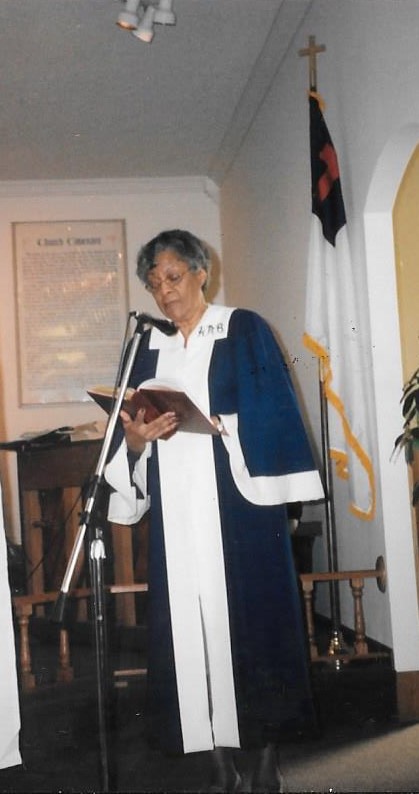
I do have some fond memories of growing up in church. My mother had a beautiful singing voice and I can remember how proud I would feel when she sang hymns like Yield Not to Temptation, I’d Trade a Lifetime, In Deep Water, or Through It All and the congregation would clap and should and some would even “catch the Holy Ghost”, except we Baptists didn’t have that cool “Holy Ghost dance” that the Church of God in Christ folks did. I loved getting my new Easter clothes, wearing a red carnation to church on Mother’s Day, eating KFC at the church picnic in the summer, and ending the year with New Year’s Eve Watch Night Service and breakfast cooked by the men of the church afterward.
But there were other aspects of life in the church that I found problematic, even from an incredibly early age. First, there seemed to be a kind of misogynistic undercurrent running through everything. Women made up the bulk of the conversation. They sang in the choir; the taught Sunday School; they organized the dinners; they planned the holiday programs. But they weren’t supposed to stand in the pulpit to speak; in fact, our church was set up where when you came down the aisle, there was a place for the senior choir on the right hand side, the pulpit in the center and the place for the junior choir on the left hand side. The choir areas and the pulpit were raised and were accessed by two steps. During Sunday School those choir spaces were used to teach different age groups. My mother and the other ladies always sent down the steps in order to cross from the right-hand area to the left. They never, ever walked across the pulpit, even when no one was sitting there.

In our church, the deacons (all men) came to each pew to pass out the elements for Holy Communion, but women were never, ever allowed to touch the trays that held the elements during the service. This always struck me as especially nonsensical since it was the ladies on the Mother’s Board (those scary, finger wagging old women who sat on the second row with their tremendous hats and dour expressions) who set up the communion table and obviously had already touched everything on it before the men had even shown up!
While not a thing in my childhood church, I attended a church when I was in my mid-thirties to early forties where the women’s auxiliary groups always had to have a man present in order to have an official meeting. I think this was the point where I truly started to pull away from the church in earnest. Normally, I’m pretty chill about “following protocol” but the idea that I, a college-educated, middle-aged woman, who worked Monday through Friday as a division manager for the largest insurance company in the United States, and who regularly called and ran meetings in the Executive Conference Room at my office, couldn’t conduct a meeting of an all-female church group without a man present, was beyond ridiculous.
It was about the same time in my life that I began to be aware of deep conflicts between church doctrine and an increasing number of scandals within the church. In the summer1998, the Southern Baptist Convention sparked great controversy when then amended their official church doctrine to state that a wife should “submit herself graciously” to her husband’s “servant leadership”. This move solidified a theological stance known as complementarianism—which views men and women as having different, ordained roles—and faced backlash for potentially promoting sexism, while supporters argued it was a return to biblical, traditional family values. Meanwhile, also in the summer of 1998, the Reverend Henry Lyons, President of the National Baptist Convention was indicted by a federal grand jury on charges of fraud, extortion, money laundering, conspiracy, and tax evasion. Lyons cheated on his wife, stole from charities, and committed tax fraud. I remember thinking, ”Is this an example of the ‘superior male leadership’ that his wife would need to submit to, if she waned to be considered a good Christian woman?”

However, it was not only the traditions of the church that I found difficult to reconcile; the more I studied, the more challenging it became to accept the Bible as the “inerrant word of an omniscient, omnipresent, omnipotent, all-loving God.” Even when I was a child, I found the story of Adam and Eve in the Garden of Eden quite troubling. God had already created everything, so what was the purpose of creating a Tree of Knowledge of Good and Evil and a Tree of Life? If God is all-knowing, he had to have known that Adam and Eve would eat of the fruit, so why put the tree in the garden to begin with? Where did evil come from? Did God create evil? The creation story starts off by saying that the earth was “formless and empty.” That suggests complete nothingness, which would mean that God had have created both evil AND good. However, what would be the point of that? We’re told that God’s creation was perfect and that mankind spoiled it through disobedience, but wouldn’t an all-powerful, all-knowing God have creating some sort of fail-safe apparatus to prevent the complete destruction of His perfect creation? And why did Adam and Eve’s sin doom the rest of humanity for all time? Aren’t we all individuals, uniquely created by God?
Jesus and the crucifixion/resurrection story always bothered me a little as well. Every Sunday School and Vacation Bible School kid at some point has to memorize John 3:16 – “For God so loved the world that he gave his only begotten Son that whosoever believes in Him, shall not perish, but have life everlasting.” Now, today, as a mother who has lost an only son, I get how that represents the greatest sacrifice that any parent can make. I also get that crucifixion is a horribly painful and shameful way to die. Yet, one thought always nagged at me, even as I was getting dressed in my new Easter clothes. Jesus was only actually dead for about 36 hours and if God is all-knowing, then God would have already known that Jesus wasn’t going to stay dead for long. Plus, as soon as Jesus died, wouldn’t he have been immediately reunited with his Father in heaven anyway? I mean, not to be rude but, that doesn’t sound like this great demonstration of sacrificial love that organized religion makes it out to be.
So, I’m sure that some people are wondering, “Does all this mean that you are an atheist now?” My answer to that would be, “No.” I do believe that there is some sort of higher power which exists on a spiritual plane. I believe that our souls live on after our physical bodies die and decay. However, I no longer believe that the Bible is the path to understanding or connecting with that higher power. The Bible was written by humans and humans created “God” in the image of humans, not the other way around. Why do I think this? All you have to do is read the Bible, especially the Old Testament. The God of the Old Testament is jealous and petty. He throws temper tantrums that result in a flood that wipes out all life on the planet except for that which Noah preserved in the Ark. God instructs Abraham to kill his son Isaac in a twisted test of loyalty, only at the last minute to say, “Nah, Bruh, just kidding.” Finally, we’re taught that we are “all God’s children, and He loves us all,” the Bible clearly shows that God plays favorites: the children of Israel are God’s “chosen people;” God is apparently ok with Jacob and Rebecca cheating Esau out of his birthright by means of deception; God favors David even though he is an adulterer and causes the death of Bathsheba’s husband Uriah to cover up his adultery. What these stories suggest to me is that the writers of these ancient texts were simply ordinary people attempting to justify their own bad behavior through asserting that these characteristics were simply inherited from Almighty God.
If I had to describe my religious preference, at this point I would say that I believe in Spiritualism. I lost my 23-year-old son to suicide in 2014. Desperate for answers and healing that traditional religion wasn’t bringing me (a so-called Christian told my mother that her grandson was burning in hell AT HIS FUNERAL!), I began reading about the afterlife and stumbled upon information about Spiritualism. I had always associated Spiritualism with seances and the fake mediums of the Victorian age who supposedly oozed ectoplasm as they communed with those in the spirit world. But as I learned more through my reading, I found that Spiritualism aligned more closely with my personal values that Christianity ever did.
First, Spiritualism does not believe in any sort of infallible text or strict doctrine. Truth comes from direct knowledge and spirit communication. Next, Spiritualism views God as Infinite Intelligence, Universal Mind, or Creative Force. The divine is everywhere and within everything and humans are spiritual beings who are on a journal to evolve both morally and intellectually. There is no “fire and brimstone” hell, but souls dwell in distinct levels between physical lifetimes depending upon how far they have advanced toward their ultimate purpose. Spiritualists also believe that Jesus was one of many enlightened teachers, but belief in Him is not required for salvation. Finally, within Spiritualism, our deceased loved ones remain available to us and are there to assist us on our soul journey.
With Spiritualism there is no longer the thorny problem of, “Why do bad things happen to good people?” The so-called “bad things” are simply learning experiences that our souls choose in advance because we want to learn certain lessons and to make specific progress on our journey. There isn’t some old man with a long white beard sitting on a throne in the sky throwing thunderbolts at some people while allowing others to simply skate through life with ease. Some of us are just extra ambitious (and perhaps a bit cocky) regarding how much adversity we can handle and so we sign up for the most difficult challenges imaginable. Additionally, people we view as “evil” may simply be souls who have agreed to play the role of “villain” in the soul journeys of others. This is part of their journeys, and they achieve growth by fulfilling this purpose.
As far as spirit communication goes, I don’t own a Ouija board or call the Psychic Hotline on a regular basis. There is, however, a community of tested and certified psychics in Lily Dale, New York. (Check out the 2011 documentary, No One Dies in Lily Dale). A few times a year, I will schedule a reading with one of the psychics that I trust and feel that I genuinely connect with my son, my parents, and occasionally other departed friends and family. It gives me a sense of peace that they are all ok; that they are progressing in their soul journeys on the other side, and that they are with me whenever I need them.

While this may sound strange or even blasphemous to die hard Christians, to me it makes much more sense than that idea that we are placed here to walk around in blind obedience to a God who at times embodies the worst of human characteristics while claiming infallibility. Believing that my struggles are situations that I chose in order to grow in very specific ways makes it much easier to cope with the adversity that comes my way. It also has helped me become more confident in how I interact with other people, since I understand that they have perhaps chosen me to play a particular role in their journeys. No longer do I live with the near paralyzing fear that with one false move I could end up burning in hell forever. Now I simply recognize that at the end of my time here on Earth, my life review will reveal whether I met my goal or not. If yes, then just like Ms. Pac-Man, I advance to the next level. If not, then I’ll regroup, plan a new journey, and one day start again.
 quietlyradical